Philip Preobrazhensky and Ivan Bormenthal relationship
The Heart of a DogThe relationship between Professor Preobrazhensky and Doctor Bormenthal is at once that of senior surgeon and trusted colleague, and of creator and co-responsible witness to an experiment whose consequences neither can simply disown. Their bond is most clearly tested at two points: during the operation on Sharik, when the professor depends on Bormenthal’s precise assistance and admits an unexpected attachment to the dog, and later, when Bormenthal proposes a way out of the crisis surrounding Sharikov and Preobrazhensky insists on sharing responsibility rather than sheltering behind his reputation.
Professional Trust and the Operation
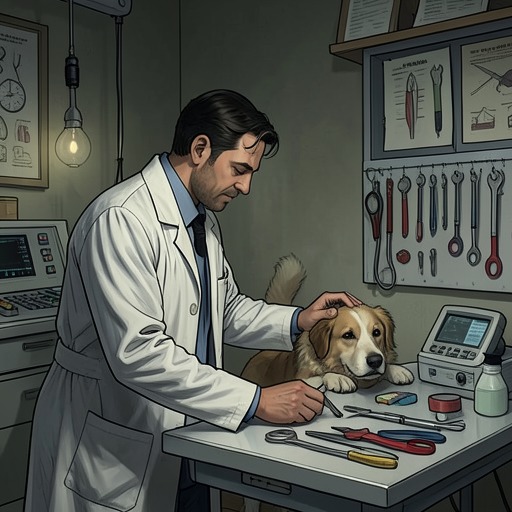
During Sharik’s operation, Preobrazhensky gives Bormenthal exact instructions for the critical moment when he enters the Turkish saddle: Bormenthal must pass him the gland immediately and begin suturing without delay. The professor warns that bleeding would cost time and put the dog’s life at risk. His instructions establish a working relationship grounded in specialized competence and coordination under pressure; Bormenthal is not a bystander but the colleague entrusted with an essential part of the procedure.
Even while concentrating on the operation, Preobrazhensky looks at the dog’s half-closed eye and says that he feels sorry for him and has grown used to having him around. The admission complicates the clinical atmosphere without displacing the procedural urgency. The dog is both the subject of an ambitious medical intervention and an animal whose presence has become personally familiar to the professor. The contrast makes the operation’s stakes relational as well as professional, while Bormenthal remains the person on whom Preobrazhensky depends to carry it through.
A Mentor’s Concern and a Colleague’s Intervention
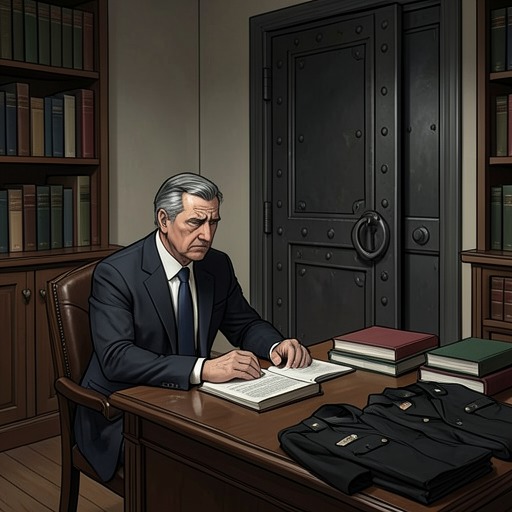
Later, Bormenthal addresses Preobrazhensky with urgency. Pale but determined, he raises his glass, then argues that the professor is worn out and no longer fit to continue working. He presents his recommendation as a way out and qualifies it with deference, saying that he would not presume to advise his mentor. His actions sharpen the appeal: he gets up, firmly shuts the corridor door, returns, and lowers his voice. The scene shows both the hierarchy between them and Bormenthal’s willingness to act when he believes Preobrazhensky’s condition demands intervention.
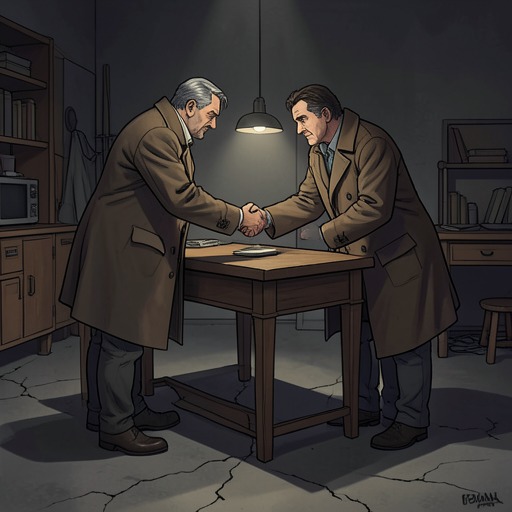
Preobrazhensky rises and gestures emphatically in response. When the discussion turns to who should face the consequences, he rejects the idea that Bormenthal should take the blame while he hides behind his worldwide reputation. He invokes his Moscow University education to distinguish himself from Sharikov, but the point is not simply professional pride: he refuses to use his standing as protection from responsibility. Bormenthal’s concern for his mentor therefore meets a countervailing concern from Preobrazhensky, who will not allow their difference in status to become a way of abandoning his colleague to the consequences.
Shared Responsibility for Sharikov
Preobrazhensky identifies Sharikov as his own experimental creation. That acknowledgment connects the relationship’s earlier surgical trust to the later crisis: Bormenthal assisted in the work, but the professor recognizes a particular responsibility in having directed the experiment and brought its result into being. His insistence that Bormenthal should not take the rap makes their professional bond an ethical one as well as a practical partnership.
Bormenthal, for his part, does not evade the difficulty by treating the result as someone else’s problem. His passionate appeal offers a course of action, and his concern for Preobrazhensky’s exhaustion gives the proposal an immediate personal dimension. The exchange does not erase the distinction between senior professor and younger doctor; instead, it makes that hierarchy the subject of their disagreement. Bormenthal speaks urgently but deferentially, while Preobrazhensky answers by accepting accountability rather than allowing his reputation to shield him.
The Relationship’s Meaning
These moments define a relationship built through shared medical work and tested by the consequences of that work. In the operating scene, trust takes the form of precise instructions and dependable assistance; in the later confrontation, it becomes a dispute over protection, blame, and responsibility. Preobrazhensky can acknowledge affection for the dog without losing sight of the operation’s risks, and he can recognize Bormenthal’s concern without accepting a solution that leaves the younger man exposed.
The bond is therefore neither merely a formal chain of command nor an uncomplicated friendship. Its strongest evidence lies in reciprocal obligations: Bormenthal is trusted with the decisive task during the procedure and later attempts to intervene on behalf of an exhausted mentor; Preobrazhensky, in turn, refuses to let his professional eminence transfer the consequences to Bormenthal. Their relationship gives the experiment a human framework of collaboration and accountability, even as the outcome forces them to confront what their shared work has produced.